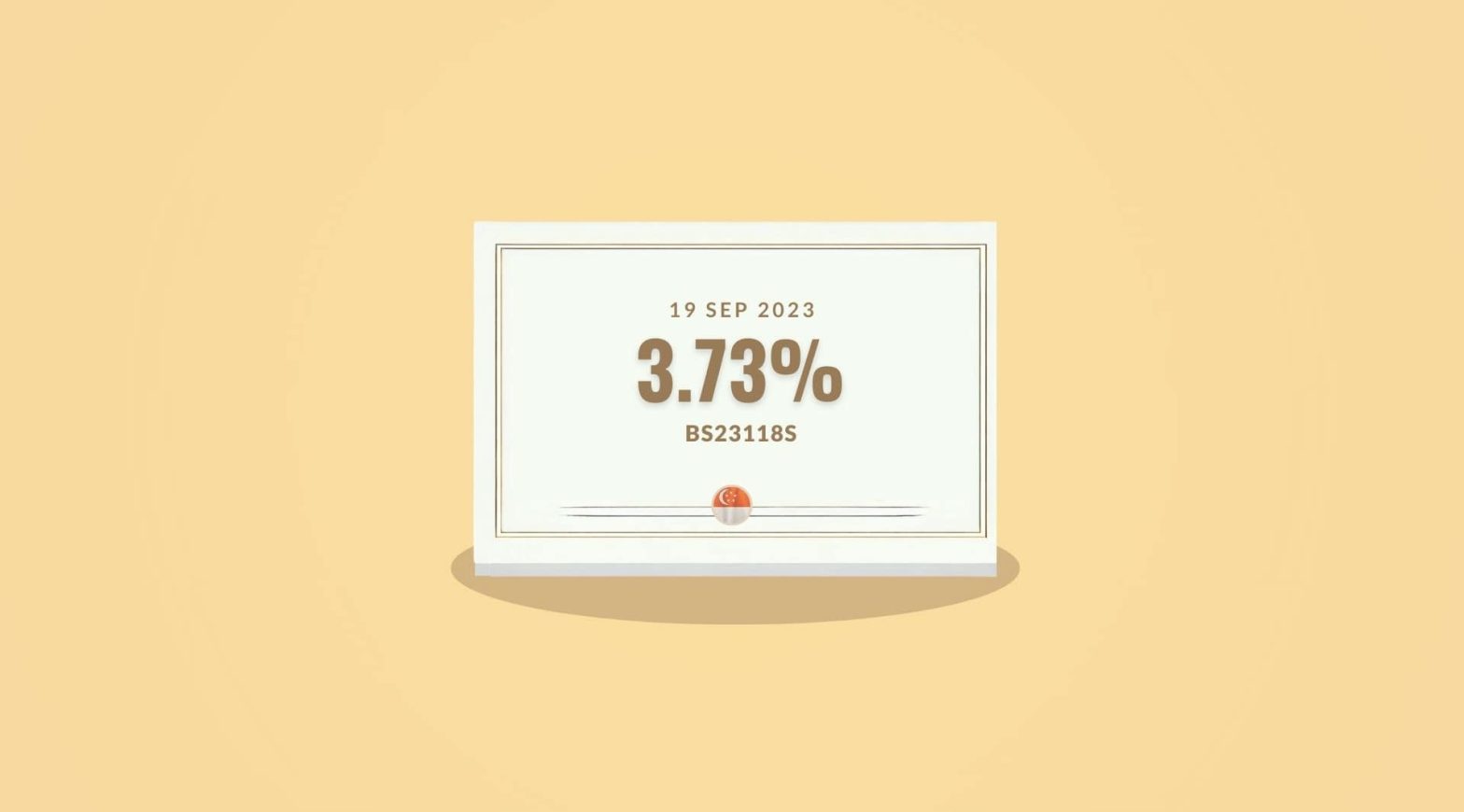
The cut-off yield for T-bill 19 Sep 2023 (BS23118S) rebounded to 3.73%. Yay! This is a positive relief for investors as we have witnessed several consecutive auctions with decreasing yields. Let’s dive deeper into the auction result.
Auction Summary
Here is the summary of the auction:
Allotment
| Total Amount Allotted | S$5.5 billion |
| Amount Allotted to Non-Competitive Applications | S$1.6 billion |
| Amount Allotted to MAS | S$0.0 million |
| Total Amount Applied | S$11.2 billion |
| % of Competitive Applications at Cut-off Allotted | Approximately 55% |
| % of Non-Competitive Applications Allotted | 100% |
| Bid-to-Cover Ratio | 2.03 |
Yield and Price
| Cut-off Yield | 3.73% p.a. |
| Cut-off Price | 98.14 |
| Median Yield | 3.58% p.a. |
| Median Price | 98.215 |
| Average Yield | 3.05% p.a. |
| Average Price | 98.479 |
Yield Finally Rebounded
After weeks of consecutive decline, we finally saw the rebound in the 6-month T-bill cut-off yield. After reaching its peak late last year, the yield continued to decline, reaching 3.70% in the previous auction. This T-bill 19 Sep 2023 (BS23118S) auction breathes a sigh of relief as the yield finally rebounded slightly to 3.73%.

The chart shows that the yield has stabilized around this level since the second quarter of this year. Let’s see if this level persists for the upcoming auctions. The good news is that the 3.73% yield is comfortably higher than the highest fixed deposit rates offered in Singapore.
Stable Demand
The demand for the T-bill 19 Sep 2023 (BS23118S) was unchanged from the previous auction at $11.2 billion. This number is on the low side compared with the last several auctions. The total non-competitive bids also stayed the same at $1.6 billion.

With the total amount offered in this auction being on the lower side at $5.5 billion, it is a relief that the cut-off yield ended up slightly higher. Because almost everything is the same as in past auctions, the slightly higher yield may be attributed to marginally higher bids from market participants.
Non-Competitive Bids Stayed Muted
There is another positive takeaway from this auction. Total non-competitive bids were only $1.6 billion, well below the 40% threshold of $2.2 billion. As a result, all non-competitive bidders got their full allocation in this auction. Yay!
We have been monitoring the non-competitive vs. competitive bid amounts and noticed that, in the past several auctions, we no longer see the non-competitive bid threshold being hit. Going forward, we will keep monitoring this non-competitive bid amount to see whether this trend persists. After seeing that the limit was not met again in this auction, we are now more confident in submitting non-competitive bids in the upcoming auctions.
What Are T-Bill Alternatives?
Investors investing in T-bills are probably drawn to them because of their almost risk-free profile and relatively competitive rates. The downside is that your capital is locked for 6 months, and there is no way to break it early without risking losing your money. Are there other alternatives to T-bills? Here are some options we use ourselves:
Fixed Deposits
This one is a no-brainer alternative. Fixed deposits have very similar characteristics to T-bills. Unfortunately, fixed deposit rates in Singapore have declined for several months. Even the highest fixed deposit offering only offers up to 3.45%. Our local banks, OCBC and UOB, offer even lower rates of only 2.70%. Euwww… Against fixed deposits, T-bills are the clear winner here.
High-Yield Savings Accounts
High-yield savings accounts offer very competitive rates for those who meet the criteria. The requirements are tricky for most people, so the realistic interest rate is usually much lower. These high-yield savings accounts may be a good option if you can meet most of the requirements. One thing to note is that the interest rate is floating. If the benchmark interest rate begins to fall, the interest rate offered by high-yield savings accounts is also likely to drop immediately. This contrasts with T-bills, which lock in the interest rate until maturity.
Cash Management Accounts
Cash management accounts are rather tricky because they have a fundamentally different risk profile. You can earn more than a T-bill, but the major downside is that your principal isn’t guaranteed. Yes, you may lose money investing in those cash management accounts. Do your research on the underlying funds of those cash management accounts to ensure you understand where your money is going. Similarly, interest rates are floating, and if the benchmark interest rate reverses, the rates these accounts offer will likely drop as well.
What Would We Do?
We like T-bills for our fixed-income portion. After comparing the alternatives, T-bills still seem like one of the better options for investors seeking fixed-income investments. We use a combination of T-bills, high-yield savings, and cash management accounts for parking our short-term cash.
What do you think? Are you interested in applying for the next T-bill? To get started, read our coverage on T-bills Singapore and how to buy T-bills.
If you plan to use CPF for the upcoming T-bill auction, use our CPF T-bill calculator to estimate how much more you can earn by investing your CPF-OA in T-bills.