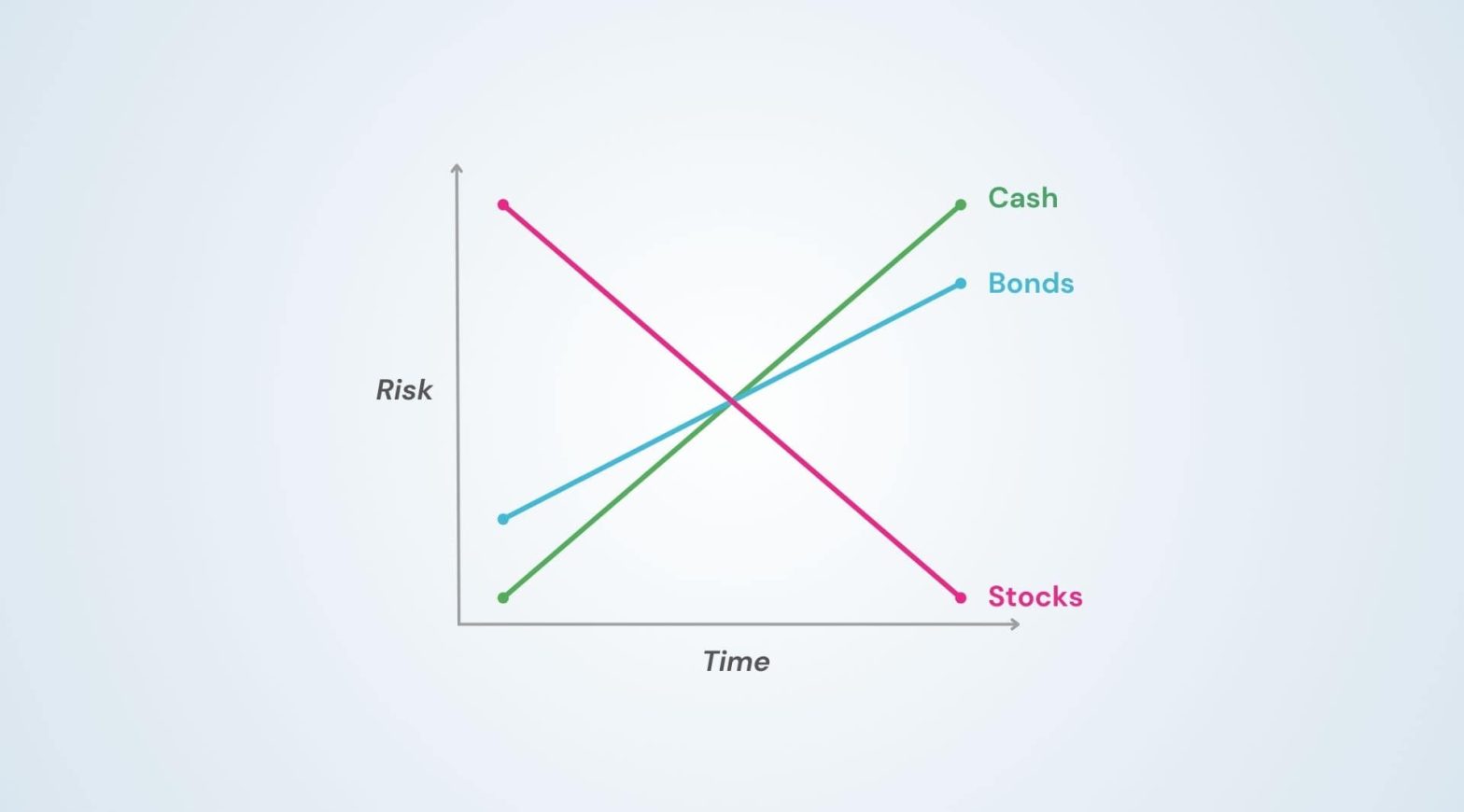
The one thing you must be comfortable with when investing is dealing with risk. Investing requires managing risk to maximize potential reward. Maybe you have heard the quote: “No risk, no reward.” Let us explore the topic of risk vs reward and see how we, as an investor, can manage our risk while trying to maximize our potential return.
Risk vs Reward by Asset Classes
If you have started investing, you should know the various asset classes you can invest in. Each of these asset classes has different risk profiles. If you sign up with a broker / financial adviser, you may have been asked to fill in your risk tolerance profile. This risk profile allows your financial adviser to asses what asset classes may suit you.

In short, the lower the risk, the lower the volatility and the potential reward. The higher the risk, the higher the volatility and the potential reward (and losses).
For the lowest risk, you can invest in government securities such as SSB, SGS, T-Bills, or fixed deposits, which guarantee your initial principal and a fixed rate of return. We call these instruments “as risk-free as you can get.”
Conversely, investing in small-cap stocks is among the riskiest options because you may lose your initial principal. Your potential return can also be higher if these small-cap companies grow into one of the largest companies in their industry. Further up the risk spectrum, venture investment in startups has an even higher risk profile. However, returns could be spectacular if the startups go public.
There are no right or wrong choices because preferred asset classes differ by investor, depending on their risk profile and investment horizon.
As an investor, you should understand the relationship between risk and reward so you can optimize your portfolio for your risk tolerance and target rate of return.
Portfolio Construction for Optimizing Risk vs Reward
As you start your investing journey, you must understand your risk tolerance so you can build a well-balanced portfolio that optimizes this risk-versus-reward tradeoff.
Another essential factor is your investment horizon. We always advocate a long-term investing mindset. Why is that? Because over the long term, the market tends to go up. However, if your investment horizon is shorter, or if you’re retired, your risk profile should be much lower than that of younger investors. Remember, higher risk means more volatility, which means your portfolio may swing wildly in the short term. It may take a long time to recover, which, if you are already retired, you probably do not want to deal with.
Most investors invest across several asset classes to improve the risk-reward tradeoff. This is called diversification. You can allocate some percentage to asset classes with higher potential returns, while keeping the rest in more stable assets to insulate your portfolio from market volatility.
As investors age, the share of risky assets in their portfolio should decrease. You can enjoy your retirement better with less volatility and more guaranteed returns.
Let’s look at several portfolio compositions that may suit various investors of different risk profiles.
Conservative Portfolio
The main goal of a conservative portfolio is to preserve capital. You can achieve this by investing a large portion of the portfolio in the lowest-risk asset classes, such as government securities or fixed deposits. While you want to avoid risky assets, investing a small portion of your portfolio in higher-yielding asset classes, such as blue-chip large-cap stocks, is usually still helpful. This composition lets you get stable returns from fixed-income investments while still enjoying some growth from riskier equities.

Another typical conservative portfolio invests most of your portfolio in physical real estate. Real estate tends to have lower volatility while still providing strong returns. The downside of owning physical real estate is managing and maintaining it, especially if you rent it out. If you are comfortable with real estate management, this is a common route investors take to build wealth. As with diversification, you can invest in other riskier assets, such as equities, to round out your portfolio.

Balanced Portfolio
A balanced portfolio seeks to achieve both growth and income. This can be achieved by dividing the portfolio equally between fixed income and equities. This portfolio has a higher risk level than a conservative portfolio; therefore, it is recommended only for investors with a higher risk tolerance and a longer investment horizon.

Aggressive Portfolio
The goal of an aggressive portfolio is to achieve long-term capital growth. This is the highest end of the risk-reward spectrum. To achieve capital growth, the portfolio will consist mainly of equities. Depending on investors’ risk tolerance, some may even favor smaller-cap stocks to boost potential returns. Because a large portion of this portfolio consists of equities, volatility may be high in the short term; therefore, this portfolio is recommended only for investors with the highest risk tolerance and a longer investment horizon.

Portfolio Rebalancing
After you have completed your portfolio construction and achieved the desired allocation percentage, your job is not done. Remember that each asset class has a different expected rate of return; over time, your portfolio allocation may change as some assets grow faster than others. If you still prefer the same portfolio allocation, rebalance by selling the overweighted asset and buying the underweighted one.
You should also regularly assess your investment objective to see whether your current portfolio still suits you. If your investment objective changes, you should adapt your portfolio accordingly. For example, if you decide to retire earlier than expected, you may want to adjust the risk level of your portfolio as well.
Which is right for you?
You know your risk tolerance and investment horizon best. You can adopt one of the portfolio compositions above and adjust it to suit your investment preference. For example, if you want a balanced portfolio but still favor more growth, you can shift to 60% equities and 40% fixed income. When you work on your portfolio construction, remember the relationship between risk and reward so you can optimize your portfolio well.
Case Study of Stock and Bond Portfolio
One of the most common portfolio compositions is a mix of bonds and stocks. We can see how different compositions affected investment returns based on 90 years of investment data from 1926 to 2019. The following chart portrays the relationship between risk and reward.

The most conservative portfolio has the lowest average annual rate of return (5.3%). However, it also has the least drawdown (-8.1%). On the other end, the most aggressive portfolio has the highest average annual return (10.3%) but the largest drawdown (-43.1%). Before adopting the more aggressive portfolio, make sure you’re comfortable with the volatility. Happy investing!
| Stock | Bond Allocation | Average Annual Return | Best Annual Return | Worst Annual Return |
|---|---|---|---|
| 0% | 100% | 5.3% | 32.6% | -8.1% |
| 10% | 90% | 6.0% | 31.2% | -8.2% |
| 20% | 80% | 6.6% | 29.8% | -10.1% |
| 30% | 70% | 7.2% | 28.4% | -14.2% |
| 40% | 60% | 7.8% | 27.9% | -18.4% |
| 50% | 50% | 8.3% | 32.3% | -22.5% |
| 60% | 40% | 8.8% | 36.7% | -26.6% |
| 70% | 30% | 9.2% | 41.1% | -30.7% |
| 80% | 20% | 9.6% | 45.4% | -34.9% |
| 90% | 10% | 10.0% | 49.8% | -39.0% |
| 100% | 0% | 10.3% | 54.2% | -43.1% |
[1] Stocks represented by the Standard & Poor’s 90 Index from 1926 to 3 March 1957; the S&P 500 index from 4 March 1957 through 1974; the Wilshire 5000 index from 1975 through 22 April 2005; and the MSCI US Broad Market Index until 2019. Bonds are presented by the S&P High Grade Corporate Index from 1926 through 1968; the Citigroup High Grade Index from 1969 through 1972; the Bloomberg Barclays U.S. Long Credit AA Index from 1973 through 1975; and the Bloomberg Barclays U.S. Aggregate Bond Index until 2019.