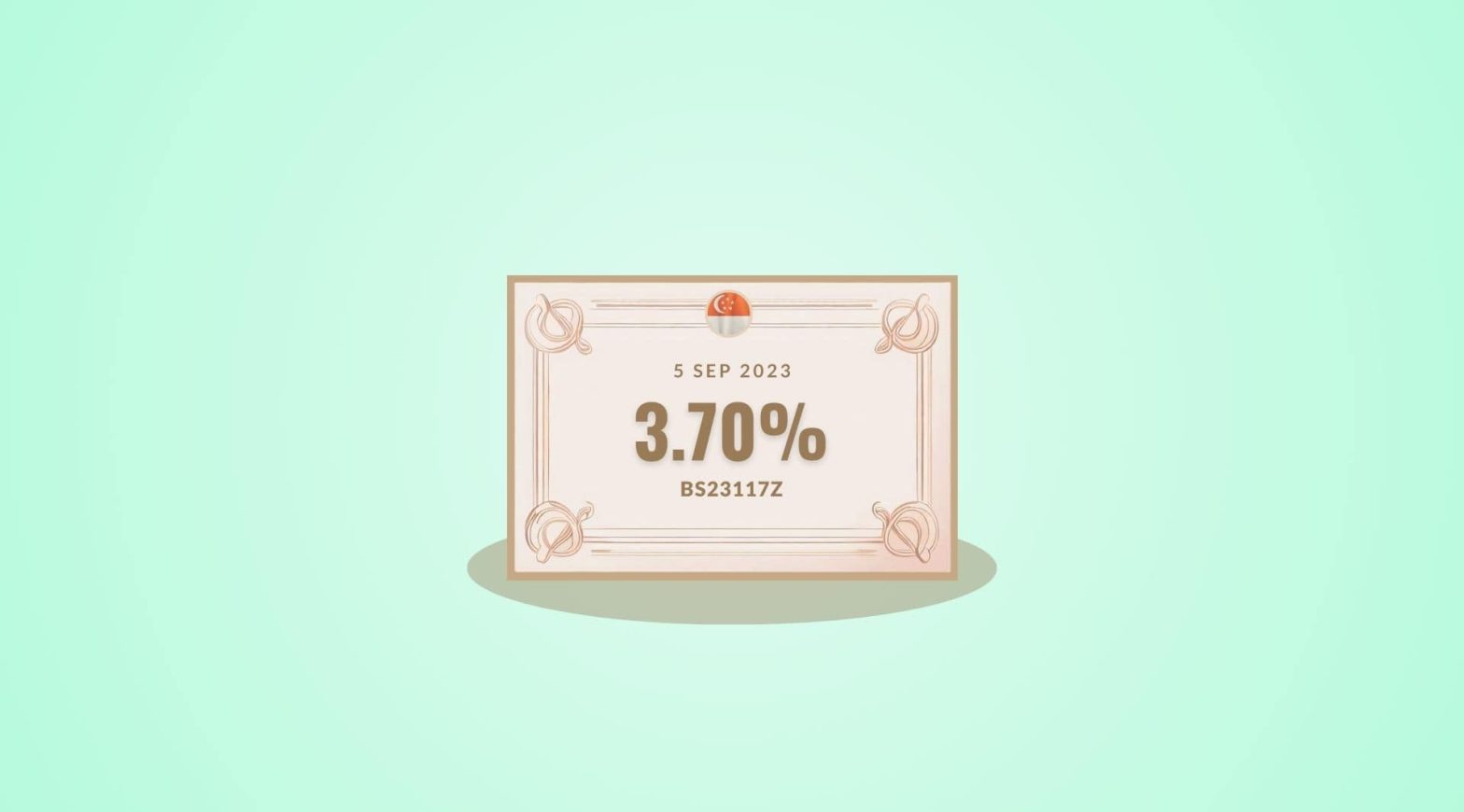
The auction for T-bill 5 Sep 2023 (BS23117Z) has concluded, and the cut-off yield was 3.70%. This is yet another continuation of the declining yield we have seen in the recent auctions. The auction result may disappoint some investors because we still saw a 3.99% yield back in July 2023. Here is the auction result summary:

Yield Dropped Further
We have seen the overall trend of T-bill yield declining this year. From its peak of 4.4% seen late last year, the yield has declined, reaching 3.70% in this auction. Despite the drop to 3.70%, the current yield is still one of the highest in recent times. It is still much higher than the yield from just one year ago.

This declining yield contrasts with the US T-bill yield, which continues to climb as the Fed continues its rate hikes. What could cause Singapore’s T-bill yield to decline?
Demand Dropped
This T-bill 5 Sep 2023 (BS23117Z) auction saw a low demand of $11.2 billion. This is a significant drop from the previous auction of $11.8 billion. However, the number of non-competitive bids remained stable at $1.6 billion.

The total offering for this auction was slightly lower at $5.5 billion. Although likely not significant, this lower offering amount may have contributed to the lower cut-off yield in this auction. Regardless, we still think other factors are at play because global interest rates continue to rise, especially in the US, while Singapore yields move in the opposite direction. Regional risk in China may affect this auction because Singapore government bonds are usually seen as among the safest instruments in the market. However, given the low demand, we don’t think this will significantly affect the auction result.
Maybe most investors just want their allocation and don’t mind bidding lower to ensure full allocation. Given that few alternatives yield as much as T-bills, this could explain the lower auction result.
Non-Competitive Bids Stayed Low
Good news for this auction: non-competitive bids stayed low at $1.6 billion, well below the 40% allocation of $2.2 billion. This means all non-competitive bidders got the full allocation they applied for.
Since mid-year 2023, we have seen a relatively high non-competitive bid amount, with some auctions reaching the maximum allocation. The continued lower non-competitive bids in this auction are welcome for many retail investors who prefer to submit non-competitive bids.
We will continue to monitor competitive vs. non-competitive bid amounts in upcoming auctions to see whether the trend persists. If we continue to see these lower non-competitive bids, we can safely switch to non-competitive bids while ensuring we get the full desired allocation. As for the next auction, we will still submit competitive bids.
T-Bill Alternatives
Fixed Deposits
For investors who are not satisfied with the current yield of 3.70%, where should they look for alternatives? The most obvious one is fixed deposits. Unfortunately, fixed deposit rates in Singapore have also declined this year. For example, OCBC and UOB offer only 2.70%, while CIMB’s highest offer is 3.55%. Currently, T-bills are still a more attractive option than fixed deposits.
High-Yield Savings Accounts
How about high-yield savings accounts? They are a good option for some of us who can meet their requirements. To earn a higher interest rate, you usually must meet specific criteria, such as being paid by direct deposit, using a credit card, or buying insurance. These savings accounts may not be for you if you cannot meet those criteria. Additionally, these savings accounts offer only a floating rate, which means the interest rate may be slashed at any time. We recently saw this with GXS Bank, which cut its rate from 3.48% to 2.68%.
Cash Management Accounts
Cash management accounts still offer decent rates. You can still get higher rates above the current T-bill yield of 3.70%. However, please note that your initial principal is not guaranteed with these cash management accounts. You can choose the level of risk you are comfortable with for your account, and the higher the risk, the higher the potential return, as well as the volatility of your principal. Please ensure you understand where your money goes by researching the underlying instruments the cash management accounts invest in. Also, the interest rate is floating, which means it may drop as soon as interest rates start to reverse downward.
What do you think? T-bills still seem like one of the more attractive options for fixed-income investors in Singapore.
Are you interested in applying for the next T-bill? To get started, read our coverage on T-bills in Singapore and how to buy T-bills.