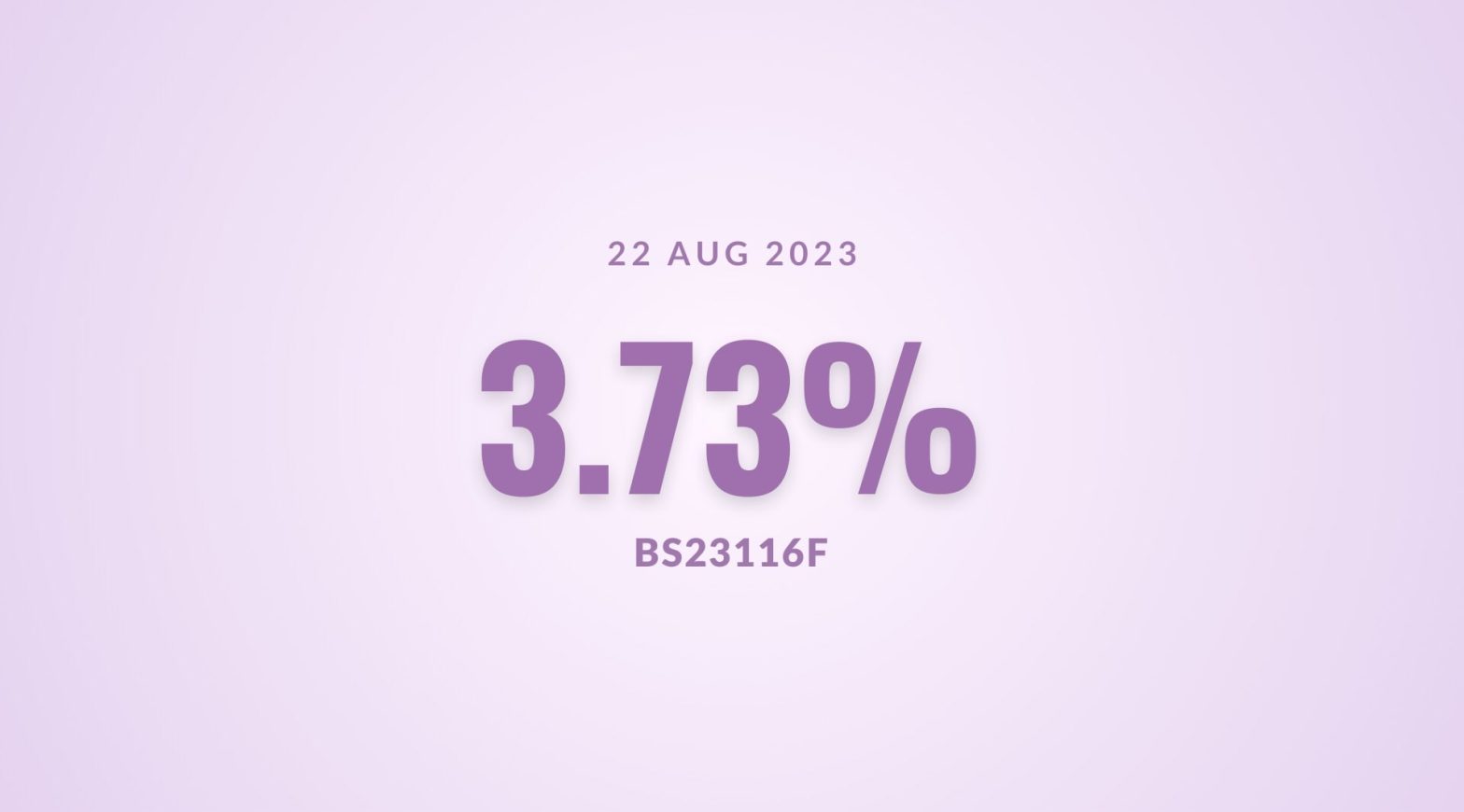
The auction for T-Bill 22 Aug 2023 (BS23116F) has concluded with a cut-off yield of 3.73%. The result is somewhat expected and only slightly declined from the last issuance’s result of 3.75%. This result continued the trend of declining yield we started seeing in early July 2023.
Let’s see the summary of this auction:

Yield Continued to Decline
There is a divergence between the Singapore T-bill yield and the US T-bill yield. While the US T-bill yield continues to rise, Singapore’s continues to decline. This T-Bill 22 Aug 2023 (BS23116F) confirmed this trend.

After reaching a local high of 3.99% in Jun 2023, the yield has steadily declined in recent auctions. In contrast, the US Treasury yield continues to rise and has been stable in the past several weeks:

Despite global central banks continuing to hike rates, Singapore T-bills have bucked the trend and started to decline. What do you think caused this decline?
Lower Demand
We also saw a decline in the total application amount, which totaled $11.8 billion. This dropped from the previous auction, which reached $12.3 billion. This auction also broke the trend of increasing demand that we saw in the last several auctions.

Additionally, the amount offered in this auction is slightly higher at $5.6 billion (up from $5.5 billion in the previous auction). Even with a higher offering amount and lower demand, the yield still declined. Because the lower-rate trend is only seen in Singapore T-bills, it seems like a ‘flight to safety’ may be at play. Singapore government bonds are seen as one of the safest instruments for Asian investors to park excess liquidity. However, for now, the exact reason remains to be seen.
Lower Non-Competitive Bids
The T-Bill 22 Aug 2023 (BS23116F) auction saw relatively lower non-competitive bids, at only $1.6 billion. In previous auctions, we saw higher non-competitive bids, even exceeding the 40% allocation limit. This could be one reason for the lower yield, as more bidders placed lower competitive bids to ensure they got their desired allocation.
But there’s good news for this auction: non-competitive bids dropped significantly, and every non-competitive bidder got their full allocation. Yay! We need to keep monitoring non-competitive vs. competitive bids to ensure the trend of lower non-competitive bids continues (or at least stays stable). If this trend of lower non-competitive bids persists, we can safely put in non-competitive bids going forward without worrying about hitting the maximum allocation cap.
For the next auction, we will still use competitive bids to ensure we get our desired allocation.
What About T-Bill Alternatives?
Despite declining to 3.73%, the current T-bill yield is still among the highest recently. The Singapore T-bill historical interest rates chart above shows that the current yield is still much higher than it was just one year ago. The current yield remains appealing.
How does the current T-bill yield compare to alternatives such as fixed deposits, high-yield savings, and cash management accounts?
Fixed deposit rates in Singapore have declined this year. The highest fixed deposit rate at the time of this writing only hovers around 3.5%. Singapore local banks, OCBC and UOB, even offer as low as 2.7%. Whew… we can safely say T-bills are currently more attractive than fixed deposits.
High-yield savings accounts still offer attractive rates above 4%. However, you must meet specific criteria, such as crediting salary, spending on the bank’s credit card, buying insurance, etc. A high-yield savings account can be a good choice if you can fulfill those criteria. However, the interest rate is floating. Unlike a T-bill, which locks in the rate for six months, this rate adjusts with the prevailing market rate. For example, if interest rates start to drop next month, the rate you earn on these high-yield savings accounts will likely follow suit.
Cash management accounts also offer decent rates. You can earn more than the current T-bill yield of 3.73%. Like the high-yield savings accounts, the interest rate here also floats. However, cash management accounts may not guarantee your principal. Although the risk is low, there is a chance you may lose a small portion of your principal. Please read the offering carefully before parking your cash in the cash management accounts.
Despite the pros and cons of the alternatives, T-bills remain one of the more attractive fixed-income instruments for investors seeking capital preservation and guaranteed interest.
Are you interested in applying for the next T-bill auction? Read our coverage of T-bills in Singapore and how to buy them to get started.